
SKEMA Business School shares its latest research insights with Access MBA.
The ancient wisdoms of the Enneagram provide a powerful key to unlock a level of understanding that can revolutionise team spirit, connectedness and, consequently, effectiveness. Quite clearly, as this case study shows, understanding the power and potential of the people in an agile team, and putting these at the heart of its operations, will uplift it and allow it to soar above the competition. This article highlights the findings of Zakaria Akli’s capstone project, supervised by Anke Middelmann.
In the realm of digital transformation, Agile ways of working have become a basic component for the success of many modern and established organisations. One of the core values introduced by the Agile manifesto is “people and interactions over processes and tools”.
At first glance, this value may seem self-evident, highlighting the significance of communication within Agile teams. After all, ceremonies and rituals like Scrum’s daily stand-ups and retrospectives seem to be efficient and effective to encourage open dialogue and knowledge sharing. Yet, beneath the surface lies a profound truth that often escapes corporate attention.
The power of the Enneagram
What makes some Agile teams soar while others struggle to take flight? The answer lies in unleashing the power of human-centricity.
In a groundbreaking case study conducted within one of the world’s leading consulting corporates, two Scrum teams comprising software engineers, Scrum masters, product owners, and business analysts embarked on a transformative journey. The teams were engaged in a digital transformation initiative for a key player in the energy sector headquartered in France. As a project manager, it became clear to me that the primary factor enabling these teams to excel was not technical expertise, but rather personal development.
At the beginning of this journey, the teams explored the power of the Enneagram, an ancient personality typology. The goals were to allow participants to better understand themselves and their colleagues, to uncover their most enabling capabilities within the Agile teams and equip them with sustainable approaches to tackle their unique challenges.
An emotional connection
To ensure a seamless integration of the Enneagram into their Agile practices, the coaching process leveraged a two-pillar framework. The first pillar was built on the innovative use of digital tools, delivering daily communications to participants that introduced each Enneagram type in a thought-provoking manner. These communications sparked curiosity and self-reflection, laying the groundwork for participants to delve more deeply into their individual personalities.
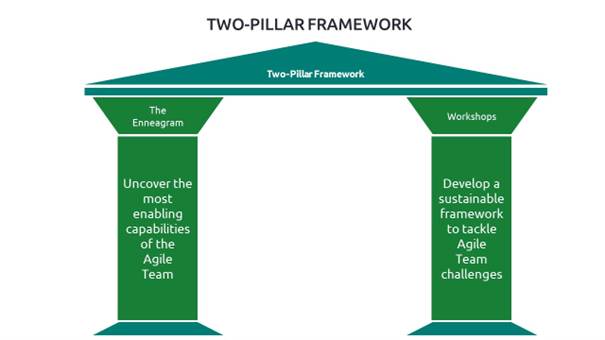
But the digital innovation did not stop there. A data-driven digital framework played a pivotal role in helping participants determine their Enneagram types accurately. Online assessments and surveys collected valuable data about each team member’s preferences, motivations, and reactions. This data provided an objective foundation for understanding their Enneagram types, elevating the accuracy of self-discovery.
Meet Jane, Enneagram Type 5
Meet Jane, a software developer on one of the Agile teams. As a key member of the team, Jane had always been admired for her technical expertise; at the same time she struggled with effective communication during team meetings. This led to misunderstandings and friction within the team, impacting the quality of their deliverables.
Through the Enneagram framework, Jane discovered that she belonged to Enneagram Type 5, also known as the “Investigator”. Armed with this insight, she learned about her tendencies to withdraw when overwhelmed with information and how this affected her interactions with the team. With this newfound self-awareness, Jane actively worked on her communication skills, embracing her team’s diverse perspectives, and leveraging her analytical strengths to contribute more effectively.
The impact was nevertheless profound. As Jane improved her communication, she noticed a ripple effect within the team. Discussions during meetings became more open, productive, and focused. Team members started to value each others’ contributions, and conflicts decreased significantly. The team, once held back by communication barriers, was now harnessing the power of human-centricity, propelling them towards excellence.
In addition to individual growth, the second pillar of the coaching framework involved organising workshops in which the Agile teams collaboratively developed sustainable strategies to tackle their specific challenges. By leveraging their newfound self-awareness and understanding of each other through the Enneagram, the teams established an unprecedented level of synergy.
More than just a personality typology
The impact of the Enneagram-based coaching was undeniable. A staggering 80% of participants expressed high satisfaction with the results, citing improved communication and better conflict resolution as the main benefits. The human-centric approach paved the way for empathy and understanding, forming the foundation for Agile synergy.
During the case study, an impressive 69% of participants reported heightened engagement levels, attributing it to the increased understanding of themselves and their teammates.
In conclusion, the Framework based on the Enneagram proved to be more than just a personality typology; it served as a catalyst for personal development and team transformation. Within the Agile context, where collaboration, adaptability, and continuous improvement reign supreme, embracing the power of human-centricity proved to be the differentiating factor.


