
Next to being Surrey Business School’s MBA Programme Director, Dr Mahdi Tavalaei is a Senior Lecturer in Strategy and Digital Transformation. He received his PhD in Business Studies (Strategy) from IE Business School, Madrid. He also holds a Master’s in Research Methodology in Management Science, an MBA in Strategy, and a Bachelor of Science in Physics.
Before joining the University of Surrey, he was an adjunct lecturer at IE University and European School of Economics, Madrid, a visiting researcher at Bocconi University, Milan, and worked in the project management field in Iran. He is a Fellow at The Higher Education Academy (UK) and a Member of the British Academy of Management’s Peer Review College.
Dr Tavalaei, how does the MBA Director make an impact on the programme and student experience?
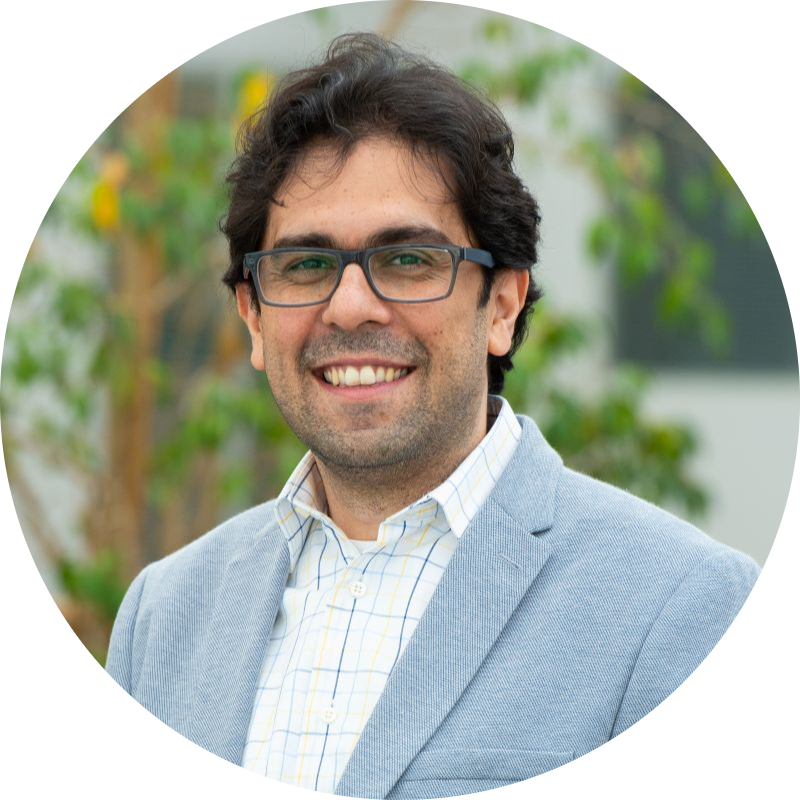 The MBA Director is essentially the architect of the student journey. I work closely with our faculty and careers team to create an integrated experience where academic rigour meets real-world application, and to ensure every student feels supported throughout their journey with us, from application to graduation. Our MBA office team aims to create meaningful connections with applicants, offer holders, and students to understand their ambitions, concerns, and what they need to thrive. When a student tells us that a module changed how they think about leadership, or that a mentoring connection opened a new career path, that’s the impact we are striving for. Ultimately, my goal is to make sure the Surrey MBA isn’t just a qualification, but it’s a turning point in our students’ professional lives.
What is Surrey’s hallmark in educating business leaders?
Surrey MBA is an MBA for change and an MBA for good! We believe the best business leaders are those who combine analytical intelligence with human insight to drive transformative and purpose-driven leadership. We don’t just teach people to analyse problems; we teach them to act decisively and responsibly in the face of complexity.
Three pillars define our approach. First, we embed data literacy and AI into the curriculum so graduates can confidently navigate the digital economy. Second, we cultivate entrepreneurial adaptability – the resilience and resourcefulness to innovate under uncertainty. And third, we offer deep industry immersion through business-relevant projects, our Career Growth Accelerator, and Global Impact Residency.
Being double-accredited by both AMBA and AACSB gives our students confidence that this programme meets the highest international standards. But beyond accreditation, what sets Surrey apart is our vibrant ecosystem of innovation, entrepreneurship, and industry partnerships, including our research centres and pan-university institutes, Surrey Research Park, and the Business Incubator, all of which feed into what and how we teach.
Last but not least, as economists often say, location, location, location! Situated in a safe and beautiful town just 35 minutes from central London, our students benefit from living in an environment that offers both tranquillity and direct access to the UK’s hub of business and innovation.
The business landscape is changing fast. How does the MBA programme anticipate the business needs and reflect them in the MBA programme on time?
This is something we take very seriously. We’ve recently redesigned the Surrey MBA to stay ahead of the curve rather than react to change. Our faculty are active researchers who publish in top journals and advise governments and corporations, so emerging trends flow directly into the classroom. We also maintain a network of industry partners who collaborate with us on case studies, consultancy projects, and guest lectures. That direct feedback loop means we’re constantly calibrating the programme against what the market actually demands.
A good example is how quickly we embedded AI and analytics not as a standalone topic, but as a thread that runs through multiple modules, alongside an AI pathway. Our students will learn the transformative power of AI, the role of human insight in an AI-driven world, tools to apply AI for various aspects of business, and the broader implications of AI on society to implement AI both strategically and responsibly.
What are the latest advancements in the Surrey MBA programme and what challenges do they address?
We’ve introduced several exciting features into our MBA. First, we now offer tailored elective pathways in three high-demand areas that closely match our university’s special capabilities and expertise: Artificial Intelligence, Entrepreneurship, and Hospitality Service Leadership. Students choose two elective modules, and they can focus on one pathway or mix and match across pathways. This focus and flexibility are something our students really value.
Second, our new Career Growth Accelerator is a four-stage professional development journey that runs alongside the academic programme. It starts before the MBA even begins, with a pre-programme activity, and culminates in the final stage, where students refine their career narrative and strategy before leaving the Surrey MBA. By the end, students will be equipped with a variety of professional and soft skills required for career excellence and leave with an evidence-based portfolio they can showcase to employers.
Third, we offer three study routes: one-year full-time, two-year structured part-time, and an unstructured part-time option, which allows students to complete their programme in five years at their own pace. The study routes, combined with the three pathways, enable students to match the Surrey MBA with their life and work commitments as well as their learning ambitions.
What do aspiring business leaders need to know about AI, human skills, competitiveness and sustainability?
This is perhaps the defining question of our era. Aspiring leaders need to understand that AI is not a threat to replace them – it’s a tool that, used wisely, amplifies their impact enormously. But the keyword is “wisely”. You need to understand AI’s capabilities and its limitations, including the ethical dimensions around bias, transparency, and data governance.
At the same time, human skills, such as empathy, creative problem-solving, and the ability to inspire and lead diverse teams, are becoming more valuable, not less so. As AI handles more routine analytical tasks, what differentiates great leaders is their capacity for strategic judgement, their ability to build trust, and their commitment to responsible innovation.
On competitiveness and sustainability, I’d say they’re no longer separate conversations. The most competitive organisations today are those embedding sustainability into their core strategy. Our modules on sustainable operations and supply change, responsible AI, and our Global Impact Residency all reflect this reality.
How does Surrey integrate AI technologies into the MBA?
As said earlier, AI is woven throughout the Surrey MBA, and it’s not confined to a single module. Our core module, AI and Decision Intelligence, introduces every student to the principles of AI and its transformative power, the extent to which AI can (or cannot) automate or augment work, data-driven business models, and practical tools such as descriptive analytics, data visualisation, and data storytelling.
Beyond the core, students can specialise further through our Artificial Intelligence elective pathway, which includes AI and Analytics Tools for Business – covering more advanced, practical tool, such as generative AI-assisted analytics, AI automation and agentic AI, and prompt engineering – and Responsible AI for Business, which tackles the critical ethical questions around algorithmic bias, surveillance, governance, and regulation. But beyond these, AI is integrated across non-AI modules, such as marketing and strategy. This cross-cutting approach ensures our graduates don’t just understand AI in theory; they know how to deploy it across every function of a business.
What is the value of MBA studies today and when is the best time to go to business school?
The world of business is more complex, more interconnected, and more volatile than ever before. An MBA gives you the frameworks to make sense of that complexity, a holistic understanding of business from strategy to operation, the network to accelerate your career, and the confidence to lead through uncertainty. What an MBA provides that self-study or short courses cannot is integration. You don’t just learn finance or marketing in isolation; you learn how these disciplines interact, how strategic decisions cascade across an organisation, and how to lead cross-functional teams through real challenges.
As for timing, the ideal moment is when you have enough professional experience to bring a meaningful perspective to the classroom but early enough that the MBA can genuinely redirect or accelerate your career trajectory. We offer full-time, structured part-time, and unstructured part-time options precisely because we recognise that the right time is different for everyone. Whether you’re an entrepreneur building your business, a professional ready to step into senior leadership, or someone pivoting into a new industry, the Surrey MBA is designed to meet you where you are.
How can students make the most of their Surrey MBA experience?
My biggest piece of advice is to lean into every opportunity. Participate actively in modules and make the most of our lecturers, who bring a wealth of experience and applied research to the class, along with diverse materials, case studies, and projects. At the same time, the MBA is as much about what happens outside the lecture theatre as inside it. Engage and network with your cohort. Our MBA cohort, coming from a diverse set of countries, work experience, and industries, is a rich resource for peer-learning.
Take full advantage of the Career Growth Accelerator and coaching activities. It’s specifically designed to help you build a compelling leadership narrative and a professional portfolio. Our dedicated career coach brings vast experience in elevating the professional skills set needed for a competitive job market. Get involved with business events and other industry connections that our university offers, such as a large cluster of companies in the Surrey Research Park and our highly experienced Executives-in-Residence.
Finally, take your assessments and the programme final project seriously. These aren’t just academic exercises; they’re opportunities to build your portfolio, test your ideas, and demonstrate your impact to future employers. Interestingly, for the final project, you can choose a consultancy project, a business plan development project, or a management research report. Choose the one that matches your career and learning aspirations. The students who get the most from the Surrey MBA are those who approach it as a holistic transformation, not just a series of modules to complete.
If you were to choose your MBA today, what factors would you consider?
Great question. First, accreditation. I’d want to know the programme meets the highest international standards.
Second, relevance. Is the curriculum actually preparing me for the world I’ll be leading in, or is it teaching yesterday’s frameworks? I’d look for a programme that has AI, data analytics, and sustainability embedded throughout.
Third, flexibility. Life doesn’t stop when you start an MBA. I’d want options; full-time if I can commit fully, part-time if I need to balance work or family. The ability to study at my own pace over two to five years would be incredibly attractive.
Fourth, the people. Both the faculty and the cohort matter enormously. I’d want to learn from academics who are actively shaping their fields through research and industry engagement, and I’d want classmates from diverse industries and backgrounds who will challenge my thinking.
And fifth, career impact. Does the programme have a track record of genuinely transforming careers? Does it offer mentoring, industry connections, and practical projects that give me a competitive edge? Surrey MBA has been designed with exactly these factors in mind!


