
If you’re planning to start an MBA in 2027, now is the time to get informed about the current admissions calendar. Missing an MBA application deadline could mean waiting weeks for the next intake and more importantly, putting your plans on hold and inviting too much uncertainty in the whole process.
This guide explains everything you need to know: key deadlines, the difference between rounds and rolling admissions, and what international applicants need to know to apply for the 2026-2027 academic year.
How MBA application deadlines work
For their admissions process, business schools either work with a series of fixed rounds or with rolling admissions.
MBA application rounds
In cases when schools operate with rounds, each round has a strict deadline. After the deadline passes, the admissions committee evaluates that batch of applications and releases their decisions.
At most top business schools, MBA aspirants apply in one of three application rounds: Round 1 in September or October, Round 2 in January, and Round 3 in March or April. Of course, the exact dates differ per school and may even change from year to year, so make sure to check the official page of your programme.
That said, not every school follows the same process. Harvard Business School (US) offers only two rounds. INSEAD (France) has four rounds per intake and offers two annual intakes (August and January), each with its own set of deadlines.
Some MBA programmes also feature early decision deadlines. They typically fall even earlier than Round 1 and allow candidates to demonstrate their commitment to their first-choice school.
Rolling MBA admissions
Then there are schools that operate on a rolling admissions basis. This means there are no fixed rounds at all. Instead of releasing their decisions in batches, these programmes review and respond to applications as they arrive throughout the year. For schools with rolling admissions, the earlier you apply, the better your chances. This applies to both admission and scholarships, since funding is usually awarded as the class fills up.
READ: How to Secure an MBA Scholarship: Types, Tips & Examples
Global MBA application deadlines 2026-2027
The table below covers the application deadlines for leading MBA programmes across the US, Europe, Canada, Asia, and Australia. Always verify directly with your target school before submitting, as dates can change between cycles.
|
Region |
School |
R1 Deadline |
R2 Deadline |
R3 Deadline |
Notes |
|
US |
9 Sep 2026 |
5 Jan 2027 |
No R3 |
||
|
US |
8 Sep 2026 |
5 Jan 2027 |
31 Mar 2027 |
||
|
US |
9 Sep 2026 |
6 Jan 2027 |
7 Apr 2027 |
||
|
US |
9 Sep 2026 |
6 Jan 2027 |
31 Mar 2027 |
||
|
US |
9 Sep 2026 |
5 Jan 2027 |
29 Mar 2027 |
||
|
Europe |
INSEAD (France) |
15 Sep 2026 |
3 Nov 2026 |
19 Jan 2027 |
4 rounds; R4: 9 Mar 2027 |
|
Europe |
24 Aug 2026 |
5 Oct 2026 |
4 Jan 2027 |
5 rounds; R4: 22 Mar 2027; R5: 4 May 2027 |
|
|
Europe |
IE Business School (Spain) |
Rolling |
Rolling |
Rolling |
|
|
Europe |
HEC Paris (France) |
Rolling |
Rolling |
Rolling |
|
|
Canada |
Rolling |
Rolling |
Rolling |
||
|
Canada |
6 Oct 2026 |
8 Jan 2027 |
2 Mar 2027 |
Early Bird: 4 Aug 2026; Final Round for domestic applicants: 4 May 2027 |
|
|
Asia |
Nanyang Business School (Singapore) |
1 Nov |
31 Jan |
31 Mar |
|
|
Asia |
Indian School of Business (India) |
20 Sep 2026 |
6 Dec 2026 |
17 Jan 2027 |
|
|
Australia |
1 Jun |
1 Jul |
1 Aug |
Multi-round |
When should you apply? Round 1 vs Round 2
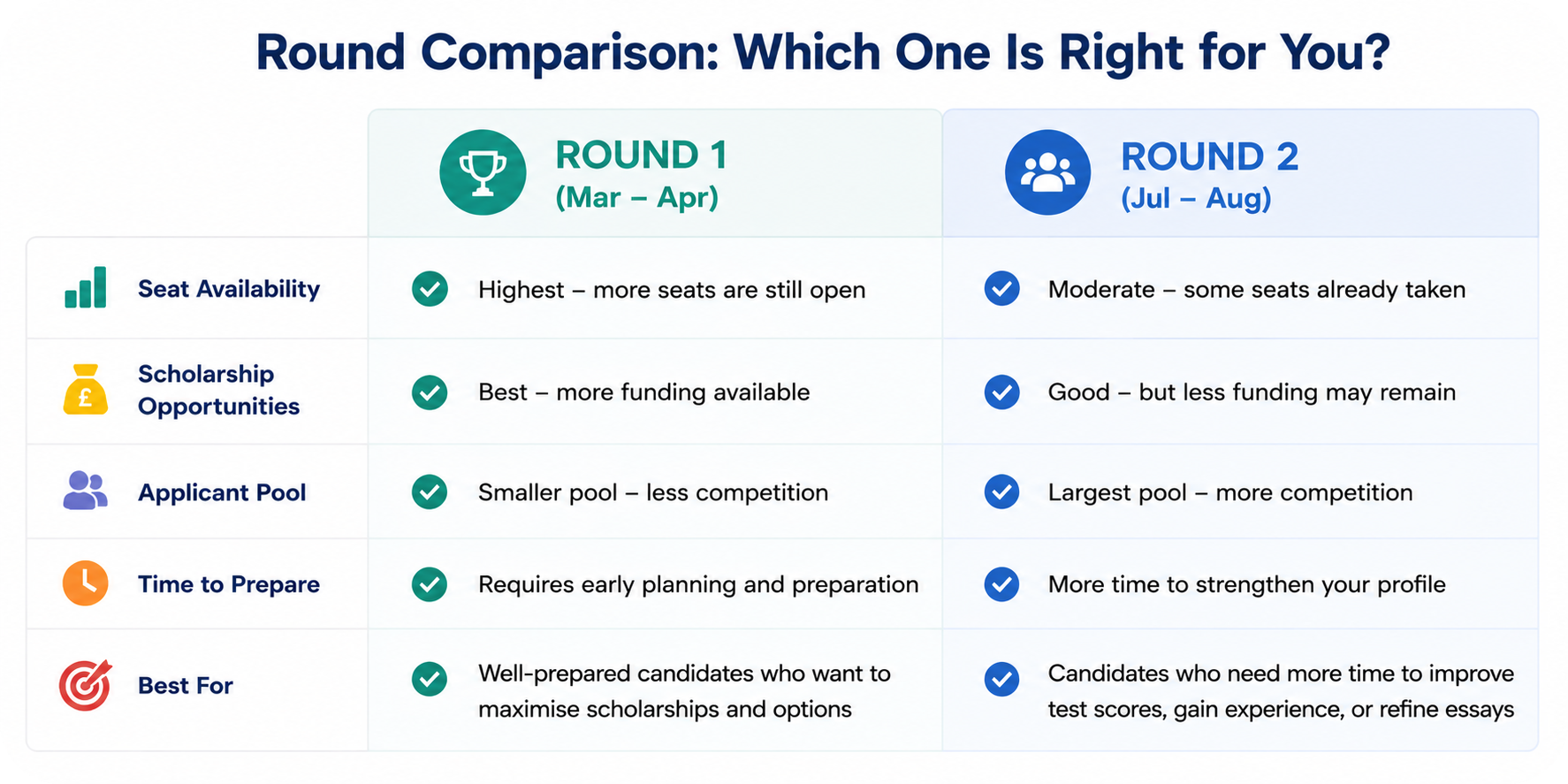
The round you apply in can affect your admission chances and access to scholarships. For international candidates, it also matters for securing a visa as this process can take time.
Round 1 is often regarded as the strongest option from which to apply. This is the period when many of the most competitive schools receive the most applications. Applying early also improves your chances to be considered for a scholarship. This is because many business schools award scholarships early, particularly in R1 and R2.
Round 2 is also a very competitive option. Many applicants use the additional time after Round 1 to work on their essays or strengthen their storytelling. Plenty of leading US schools actually fill in the remaining seats in this round so the class is far from full before then. If your application is not ready in September, a strong R2 submission will serve you much better than a rushed or incomplete application in R1.
Round 3 is a bit of a different story. It’s true that seats may be more limited here, but this is also the time when admissions committees look for “hidden gems” – candidates with standout stories or profiles that add balance to the class. Schools may even reserve classroom seats in later rounds on purpose to be able to shape and diversify their cohort. However, if you are applying in Round 3, your profile must be exceptionally strong. You will also need to act quickly, as the timeline for acceptance and visa appointments advance significantly.
In a nutshell: apply in Round 1 if your application is ready and competitive. Go for Round 2 if you need more time to improve your essays or shortlist the right schools.
READ: How to Use LinkedIn the MBA Way (And Not Waste Your Time)
What you should be doing right now
If you are targeting Round 1 of the 2026-2027 academic year, keep in mind that you may already be pressed for time. The September deadlines at Harvard, Wharton, Stanford, Kellogg, INSEAD, and Columbia are coming up very soon, which means your GMAT or GRE score should ideally be out or at least close to it.
The same goes for other parts of the application package like recommendation letters and essays. Some recommenders need at least a month or two to write a thoughtful letter. Essays take longer than most candidates expect so start drafting these as early as possible.
MBA admission doesn’t have to be a complicated process if you just plan ahead. A strong profile on paper or a high GMAT score won’t do miracles if you can’t prepare your whole application package on time. Give yourself enough space so your application ends up reflecting your potential and you will be successful. Use the deadlines in this guide as your starting point, verify the dates directly with each school, and build your timeline backwards from the round you are targeting. The sooner you start, the more options you will have.


